By Ashutosh Joshi, PGDM (Finance), B.Com · Last updated: 20 October 2026
Key Highlights
As on 20 October 2026
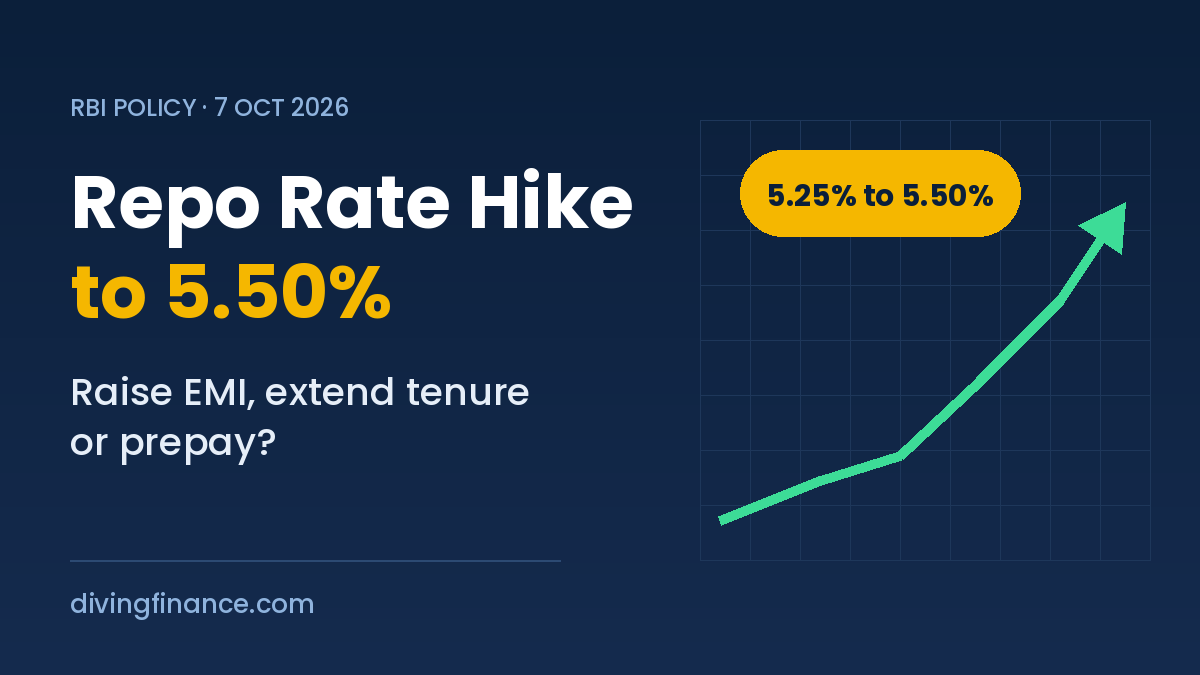
- Repo rate: The RBI raised the repo rate from 5.25% to 5.50% on 7 October 2026 and moved to a “calibrated tightening” stance.
- EMI impact: On a ₹50 lakh loan with 20 years left, a move from 8.25% to 8.50% adds ₹788 to the monthly EMI (example).
- Tenure trap: Keeping the old EMI adds 13 months to that loan and about ₹3.28 lakh in extra interest.
- Prepayment: Paying ₹2 lakh now on that ₹50 lakh loan saves about ₹8.05 lakh and ends it 23 months early (example).
- Bottom line: Raise your EMI if you can afford it, prepay if you have spare cash. The next RBI decision is 4 December 2026.
Quick answer: The Reserve Bank of India (RBI) announced a repo rate hike of 25 basis points, from 5.25% to 5.50%, on 7 October 2026. Banks are already passing it on to repo-linked home loans. My advice for most borrowers: raise your EMI if you can afford it, because letting the bank stretch your tenure costs far more. If you have spare cash, a part-prepayment beats both, and most floating-rate home loans taken by individuals carry no prepayment penalty. Take the longer tenure only if your monthly budget is genuinely tight.
What exactly did the RBI do on 7 October?
At its 63rd meeting (5–7 October 2026), the Monetary Policy Committee (MPC) voted 6–0 to take the repo rate to 5.50%. The details are in the RBI’s policy resolution.
| Policy rate | Before 7 Oct 2026 | From 7 Oct 2026 |
|---|---|---|
| Repo rate | 5.25% | 5.50% |
| Standing Deposit Facility (SDF) | 5.00% | 5.25% |
| Marginal Standing Facility (MSF) / Bank Rate | 5.50% | 5.75% |
| Stance | Neutral | Calibrated tightening |
The RBI says that under calibrated tightening, “rate cuts are off the table in the near term”, so the next move is a hike or a pause. Inflation explains why. CPI inflation rose to 4.8% in August 2026, and the RBI now projects 5.2% for 2026-27, with Q3 at 6.0%. The next MPC meeting is on 2–4 December 2026 (RBI MPC schedule 2026-27).
How does a repo hike reach my EMI?
It depends on your loan’s benchmark, which your sanction letter names.
External Benchmark Lending Rate (EBLR) or Repo-Linked Lending Rate (RLLR). Since 1 October 2019, new floating-rate retail bank loans must use an external benchmark, usually the repo rate. Under the RBI circular of 4 September 2019, the rate on these loans must be reset at least once every three months. The hike passes through fully, and fast.
Marginal Cost of Funds-based Lending Rate (MCLR). This older, internal benchmark moves more slowly and resets on the dates in your loan agreement, usually every 6 or 12 months.
Here is how quickly the big lenders moved:
| Lender | Benchmark: old → new | Effective from | Source |
|---|---|---|---|
| State Bank of India | EBLR 7.90% → 8.15% + CRP + BSP; RLLR 7.50% → 7.75% + CRP | 15 Oct 2026 | SBI EBLR page |
| Punjab National Bank | RLLR 8.10% → 8.35% | 8 Oct 2026 | Business Standard, 9 Oct 2026 |
| Bank of Baroda | BRLLR 7.90% → 8.15% | 8 Oct 2026 | Business Standard, 9 Oct 2026 |
| HDFC Bank | Repo + 2.50% to 7.95% (page uses repo 5.50%), so 8.00%–13.45% | Oct 2026 | HDFC Bank home loans |
| ICICI Bank | Repo-linked rates from 8.75% (pre-approved digital loans from 7.80%); valid till 31 Oct 2026 | Repo 5.50% from 8 Oct 2026 | ICICI Bank rates |
Indicative rates as published on lender pages and in the cited reports, checked 19 October 2026. Your actual rate depends on your spread, credit score and loan size.
SBI also raised its one-year MCLR from 8.70% to 8.85% (Economic Times, 15 Oct 2026). MCLR borrowers will see the increase at their next reset date.
So how much more will I actually pay?
Take Priya, 34, a software engineer in Pune with ₹50 lakh still outstanding on her home loan and 20 years to go (a hypothetical example). Her rate moves from 8.25% to 8.50%. Her EMI goes up by ₹788 a month. Small? If she leaves the EMI where it was and lets the bank extend her tenure, she ends up paying about ₹3.28 lakh more in interest.
The same calculation for three loan sizes:
| Outstanding loan | EMI at 8.25% | EMI at 8.50% | Extra per month | Total interest if you raise EMI | Total interest if you keep EMI (tenure +13 months) | Cost of extending |
|---|---|---|---|---|---|---|
| ₹30 lakh | ₹25,562 | ₹26,035 | ₹473 | ₹32.48 lakh | ₹34.45 lakh | ₹1.97 lakh |
| ₹50 lakh | ₹42,603 | ₹43,391 | ₹788 | ₹54.14 lakh | ₹57.42 lakh | ₹3.28 lakh |
| ₹75 lakh | ₹63,905 | ₹65,087 | ₹1,182 | ₹81.21 lakh | ₹86.13 lakh | ₹4.92 lakh |
Example only. Assumptions: 240 months remaining; the new rate applies from month 1; no further rate changes; monthly reducing balance; figures rounded. “Keep EMI” means the bank leaves your EMI unchanged and extends the tenure to 253 months. Try your own numbers in our EMI calculator.
Why letting the tenure stretch gets costly
Each new hike adds more months than the last, and long loans suffer most. Here is a ₹50 lakh loan where the borrower keeps paying the old EMI:
| Remaining tenure | Rate goes to | EMI kept at | New tenure | Months added |
|---|---|---|---|---|
| 20 years | 8.50% (+25 bps) | ₹42,603 | 253 months | +13 |
| 20 years | 8.75% (+50 bps) | ₹42,603 | 267 months | +27 |
| 25 years | 8.50% (+25 bps) | ₹39,423 | 324 months | +24 |
| 25 years | 8.75% (+50 bps) | ₹39,423 | 357 months | +57 |
Example only, starting rate 8.25%. Computed month by month.
Look at the last row: with 25 years left, one more hike pushes the loan out by almost five years, possibly past retirement. The RBI’s August 2023 reset circular requires lenders to make sure an extension never causes negative amortisation, where the EMI doesn’t even cover the month’s interest.
What choices is my bank required to give me?
The RBI circular on Reset of Floating Interest Rate on EMI-based Personal Loans (18 August 2023, updated 1 October 2025) covers home loans. Under it, your lender must:
- Tell you immediately when your EMI or tenure goes up because of a benchmark change.
- Let you choose a higher EMI, a longer tenure, or a mix of both.
- Let you prepay in part or in full at any time.
- Send a quarterly statement showing principal and interest paid so far, the EMI, the number of EMIs left and the annualised rate.
Since 1 October 2025, offering a switch to a fixed rate at reset is optional for lenders, so ask whether your bank offers it and what it charges.
Many banks extend the tenure by default. If you want the higher EMI, ask through net banking or your branch.
Raise EMI, extend tenure or prepay: how I’d decide
I usually walk clients through four questions, in this order.
1. Is your EMI already more than about 40–45% of take-home pay, or is your emergency fund under six months of expenses?
Then extend the tenure for now. Cash flow comes before interest savings. Revisit in 6–12 months.
2. Would a longer tenure push the loan past your planned retirement age or the bank’s age limit?
Then raise the EMI, even if only partly. A mix of a slightly higher EMI and a slightly longer tenure is allowed.
3. Do you have spare cash after your emergency fund and near-term goals?
Then a part-prepayment is the strongest move. Under the RBI Pre-payment Charges on Loans Directions, 2025, lenders cannot levy prepayment charges on floating-rate loans to individuals for non-business purposes sanctioned or renewed on or after 1 January 2026. Older floating-rate home loans to individuals were generally free of foreclosure charges under earlier RBI instructions too, but check your sanction letter.
If Priya prepays ₹2 lakh now and keeps her EMI at ₹43,391, she finishes 23 months early and saves about ₹8.05 lakh in interest (example calculation). If she’d rather have a lower EMI, the same ₹2 lakh brings it down to about ₹41,656 over the original 240 months.
4. Should the spare cash go to prepayment or to investments? Compare your loan rate with the post-tax return you can realistically expect.
Under the old tax regime, interest on a self-occupied home loan is deductible up to ₹2 lakh a year under Section 24(b) of the Income-tax Act, 1961, which lowers your effective cost. Under the new tax regime that deduction isn’t available for self-occupied property (Income Tax Department FAQs). From Tax Year 2026-27, sections are renumbered under the Income-tax Act, 2025, so check the corresponding section. Equity SIPs can beat 8.5% over 10+ years, with no guarantee.
Our Home Loan Prepayment vs Investment calculator runs both paths side by side; pair it with the step-up SIP calculator.
My view: prepay when your loan rate beats the post-tax return you can realistically earn elsewhere, and only after six months of expenses sit in an emergency fund. Prepaying earns a guaranteed return equal to your loan rate, 8.50% in Priya’s case. But if you’re early in a long investing horizon, don’t stop your SIPs to do it. Send bonuses and lump sums to the loan instead.
Is it worth refinancing or switching benchmarks?
Still on an MCLR-linked or old base-rate loan? Compare it with your bank’s EBLR offer; switching usually costs a conversion fee. A balance transfer makes sense only if the rate gap covers processing, legal, valuation and stamp-duty costs.
What should I watch before the December policy?
- CPI data for September and October 2026. The RBI expects Q3 inflation near 6.0%. A hotter number makes another hike more likely.
- The MPC minutes, out on 21 October 2026.
- Your own reset date. The October hike will show up in your EMI or tenure at your next reset, whatever happens in December.
I won’t predict December. But the RBI’s own Q3 inflation projection of 6.0% keeps another hike possible, so stress-test your EMI at 0.25% and 0.50% above today’s rate and keep that amount spare each month. On Priya’s ₹50 lakh loan, 8.75% would mean an EMI of ₹44,186, about ₹1,583 above her old EMI.
Frequently asked questions
What is the repo rate now?
5.50%. The RBI raised it by 25 bps from 5.25% on 7 October 2026. The SDF rate is 5.25% and the MSF/Bank Rate is 5.75%.
How much will my EMI rise after a 25 bps hike?
Roughly ₹15–16 for every lakh outstanding, on a 20-year remaining tenure in our 8.25%→8.50% example. On ₹50 lakh that is ₹788 a month. Our EMI calculator gives your exact figure.
Is it better to increase EMI or extend tenure?
If your budget allows it, increase the EMI. In our ₹50 lakh example, extending the tenure costs about ₹3.28 lakh more in interest. Extend only if cash flow is tight.
Can my bank extend my tenure without asking me?
Under the RBI’s August 2023 circular, the bank must tell you immediately about any EMI or tenure change and offer a higher EMI, a longer tenure or a mix. If it hasn’t, write to the bank and ask for the option.
Will I pay a penalty for prepaying my home loan?
Generally not, for individual floating-rate home loans. RBI’s 2025 Directions bar prepayment charges on such loans sanctioned or renewed from 1 January 2026, with no lock-in. Check your sanction letter for older or fixed-rate loans.
When is the next RBI policy decision?
The MPC meets on 2–4 December 2026, and the decision comes on 4 December.
Disclaimer: This article is for education only and is not investment, tax or legal advice. EMI figures are illustrative calculations based on the stated assumptions, not offers from any lender. Rates and rules change, so verify with your lender and the linked official sources, and consult a SEBI-registered investment adviser or chartered accountant for advice on your situation.
Related reading: What is a loan? Types of loans explained · FD calculator · SIP Stoppage Ratio July 2026: what the AMFI data really means