Every time a buyback is announced, the same question turns up in the comments here: “record date kab hai, main apply kaise karun?”
From 1 August 2026, for a large chunk of buybacks, that question stops having an answer. Not because the information is hidden. Because there is nothing to apply for.
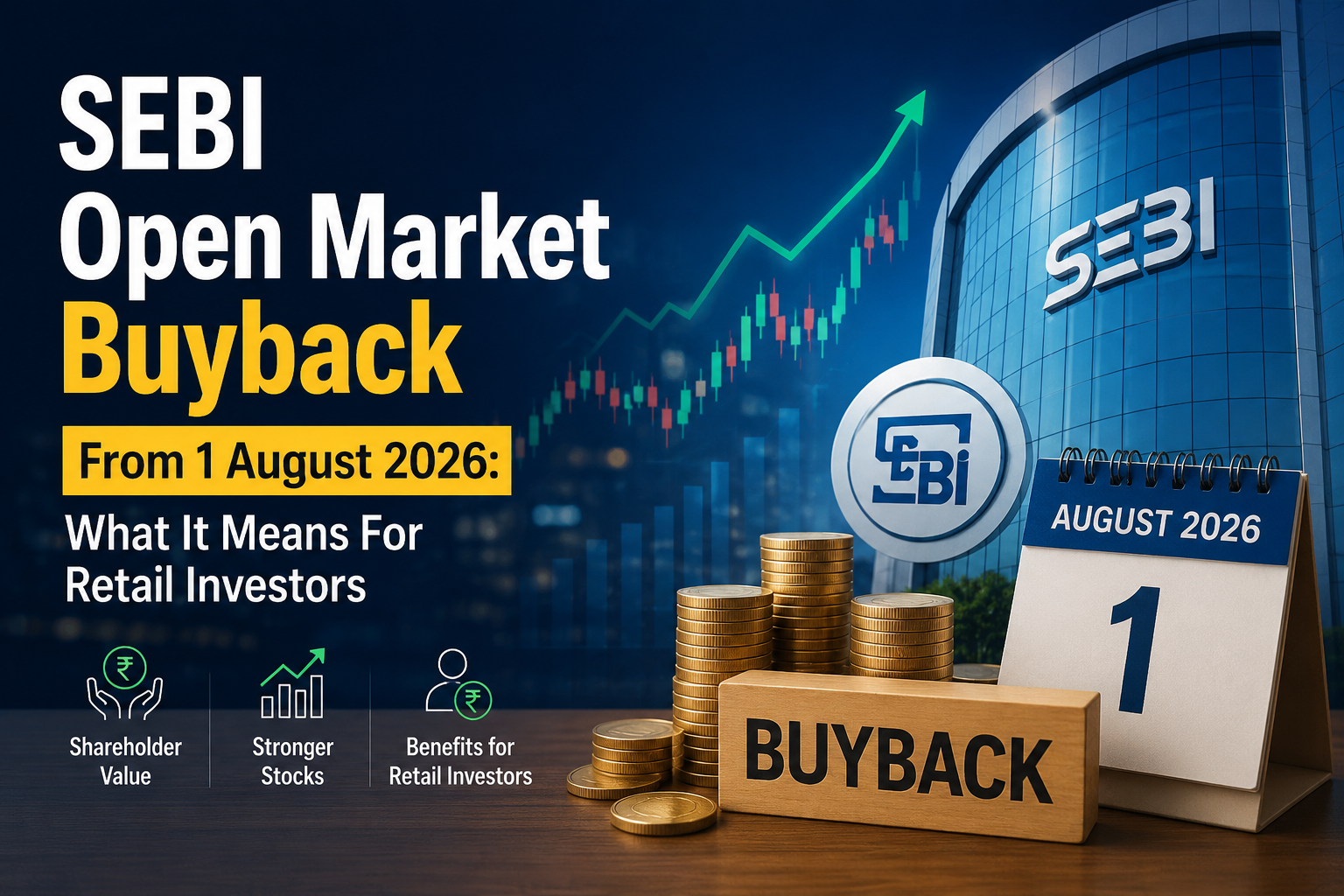
SEBI has brought back the open market buyback route — the one where a company simply buys its own shares off the exchange like any other buyer. It was shut in April 2025. The notification restoring it came on 1 July 2026, after the board cleared it on 19 June, and it goes live on 1 August.
Most of the coverage has treated this as a corporate governance story. It is also a story about how retail investors are going to get confused for the next few months, so let’s sort it out properly.
What actually changed on 1 August 2026
Until now, an Indian listed company had two ways to buy back shares: a tender offer (fixed price, you tender your shares, you get a proportionate acceptance) and book-building. The third route — buying on the open market through the stock exchange — was phased out from April 2025.
SEBI’s reason for killing it was reasonable. Exchange buybacks run on price-time priority, the same matching logic as any other trade. Whoever’s order sits at the right price at the right moment gets filled. An algo desk watching the tape does better than a retail investor checking their portfolio on Sunday. Add the tax structure of the time, and the route was tilted.
Two things have since changed. The tax distortion got fixed in Budget 2026. And SEBI has bolted a set of guardrails onto the route before reopening it. 1 Oct 2024 Buyback money taxed as dividend, at your slab rate Apr 2025 SEBI shuts the open market route 1 Apr 2026 Tax flips back to capital gains — you deduct your cost 1 Aug 2026 Open market route reopens Both the route and the tax treatment reversed within 16 months of each other.
Two separate reversals — one by SEBI, one in the Finance Act — that happen to land together.
The bit nobody is saying clearly: you cannot participate
This is the part worth internalising before the first open market buyback lands on your screen.
In a tender offer, you are a counterparty. There is a record date. If you hold shares on that date you get an entitlement — small investors get a reserved 15% quota — and you tender them at a fixed price that is usually well above market. You fill a form on your broker’s app. You know exactly what you did.
In an open market buyback, none of that exists. The company places buy orders on NSE or BSE during normal trading hours. Those orders sit in the same order book as everyone else’s. If your sell order happens to match one of theirs, congratulations, you sold to the company. You will never know. There is no record date, no entitlement, no form, no acceptance ratio.
So what does it do for you? It puts a large, persistent, price-insensitive buyer into the stock for up to 66 working days. That supports the price. That’s the benefit — and it accrues to you whether you sell or not. There is nothing to apply for and nothing to miss out on. TENDER OFFER Company announces price + record date You get an entitlement (15% small-investor quota) You tender on your broker’s app Shares accepted at a fixed premium You know exactly what happened OPEN MARKET (from 1 Aug 2026) Company announces a maximum price + size It buys on NSE/BSE over 66 working days Orders match anonymously, price-time priority Nothing to apply for. No record date. You benefit from price support, not an exit
The two routes ask completely different things of you. One needs an action. The other needs none.
Side by side
| Tender offer | Open market (exchange route) | |
|---|---|---|
| Record date | Yes | No |
| Do you apply? | Yes, you tender | No — you can only place a normal sell order |
| Price you get | Fixed, usually a premium | Prevailing market price |
| Small shareholder quota | 15% reserved | None — no concept of it |
| Certainty of acceptance | Proportionate, known afterwards | Zero. It’s a market trade. |
| Time limit | Short, defined window | 66 working days from opening |
| Size cap | Up to 25% of paid-up capital + free reserves | Under 15%, on standalone and consolidated books |
| What it does to the price | Usually a one-off pop on announcement | Sustained bid over weeks |
The tax change is the bigger story for your returns
Honestly, the tax reversal matters more to a retail portfolio than the route reopening does. India has run three different buyback tax regimes in under two years.
| Period | Who pays | What gets taxed | Rate |
|---|---|---|---|
| Up to 30 Sep 2024 | The company (Sec 115QA) | Distributed income | 20% + surcharge & cess; shareholder exempt |
| 1 Oct 2024 – 31 Mar 2026 | You | Entire amount received, as deemed dividend. No cost deduction. | Your slab rate. Cost allowed separately as a capital loss. |
| From 1 Apr 2026 | You | Only the gain (buyback price minus your cost) | Listed shares: 12.5% LTCG / 20% STCG |
That middle regime was brutal, and it is why buyback activity fell off a cliff through FY25. If you’d bought a share at ₹800 and the company bought it back at ₹1,200, you were taxed on the full ₹1,200 at slab rate — not on your ₹400 profit. The ₹800 came back to you as a capital loss you could only use if you happened to have other capital gains that year. Plenty of people didn’t.
What it looks like on real numbers
Take 100 shares bought at ₹800 in January 2024, bought back at ₹1,200. Proceeds ₹1,20,000, cost ₹80,000, held over a year.
| Regime | Taxable amount | Tax | In your hand |
|---|---|---|---|
| Pre-Oct 2024 | Nil for you | ₹0 | ₹1,20,000 |
| Oct 2024 – Mar 2026 (30% slab) | ₹1,20,000 | ₹37,440 | ₹82,560 |
| From Apr 2026 | ₹40,000 gain | ₹5,200 | ₹1,14,800 |
The last row assumes you’ve already used up your ₹1.25 lakh annual LTCG exemption elsewhere. If you haven’t, the tax on this is zero and you keep the full ₹1,20,000. What ₹1,20,000 of buyback proceeds actually leaves you with 100 shares bought at ₹800, bought back at ₹1,200, held over 12 months, 30% slab 1,20,000 80,000 40,000 0 ₹1,20,000 Pre-Oct 2024 company paid the tax ₹82,560 Oct 2024 – Mar 2026 taxed as dividend, at slab ₹1,14,800 From Apr 2026 12.5% on the ₹40,000 gain
Same buyback, same shareholder, ₹32,240 difference depending purely on which year it happened in.
A wrinkle worth understanding
Here’s something that follows from all of this but rarely gets spelled out.
If you sell shares during an open market buyback, you have no idea whether the buyer was the company or a stranger. And under the new rules it doesn’t matter, because either way it’s a normal exchange transaction with STT, taxed as ordinary capital gains at 12.5% or 20%.
That equivalence is not an accident. SEBI’s stated position is that the earlier tax framework gave shareholders who participated in a buyback a different outcome from those who simply sold in the market, and that the Finance Act 2026 change has removed that gap. Once buyback proceeds and market sales are taxed identically, an anonymous exchange-based buyback stops being a mechanism for tax arbitrage and becomes what it was always supposed to be — a company spending cash to shrink its own share count.
The guardrails SEBI added
The reopened route is meaningfully tighter than the one that was shut down.
What’s new in the framework
- Size cap: an open market buyback must be under 15% of paid-up capital plus free reserves — tested on both standalone and consolidated accounts. Tender offers can still go up to 25%.
- 66 working days to complete, from the date the offer opens. The old framework allowed up to six months, which let companies drag things out.
- Promoter shares frozen at ISIN level for the duration. Promoters can’t quietly sell into the company’s own bid.
- Minimum public shareholding protected — there’s now an explicit provision stopping a company from announcing a buyback that would push it below MPS norms.
- Electronic communication to shareholders is mandatory, on top of the newspaper announcement. A newspaper ad in 2026 was doing very little.
- Merchant banker appointment is optional for this route, which cuts cost for smaller companies.
- Gap between buybacks now follows the Companies Act, 2013 instead of a separate SEBI timeline.
The promoter freeze is the one I’d point to. The original complaint about exchange buybacks was that informed participants got the good fills. Freezing promoter holdings for 66 working days removes the most informed participant of all from the sell side.
What you should actually do about it
Not much, and that’s a real answer rather than a cop-out.
An open market buyback is not an event you trade. It’s a signal you read. A company committing real cash to buy its own stock, with a hard 66-day clock and a promoter freeze, is telling you it has surplus cash and thinks the shares are cheap. Sometimes it’s right. Sometimes it’s a board with no better use for the money, which is a different message entirely.
Three things worth checking when the announcements start:
- Where’s the cash coming from? Free reserves built from operations is one thing. A buyback funded right after a fundraise is another.
- Has this company bought back before, and did it follow through? Under the old six-month framework, plenty of companies announced a number and quietly bought a fraction of it. The 66-day clock makes that harder, but check the history.
- Is the maximum price a real price? Companies set a ceiling. If the ceiling is 40% above the current market price, the announcement is mostly theatre — the stock has to run a long way before the company is actually competing for shares.
And if you were holding shares hoping to tender them into a buyback: that opportunity is unchanged. Tender offers haven’t gone anywhere. This is an additional route for companies, not a replacement.
One thing I genuinely don’t know yet: whether companies actually use this. The route was dormant for over a year, boards have got used to tender offers, and the sub-15% cap makes it less useful for a large one-shot capital return. The first two or three announcements after 1 August will tell us more than any amount of speculation. I’ll update this post when they land.
FAQs
Every time a buyback is announced, the same question turns up in the comments here: “record date kab hai, main apply kaise karun?”
From 1 August 2026, for a large chunk of buybacks, that question stops having an answer. Not because the information is hidden. Because there is nothing to apply for.
SEBI has brought back the open market buyback route — the one where a company simply buys its own shares off the exchange like any other buyer. It was shut in April 2025. The notification restoring it came on 1 July 2026, after the board cleared it on 19 June, and it goes live on 1 August.
Most of the coverage has treated this as a corporate governance story. It is also a story about how retail investors are going to get confused for the next few months, so let’s sort it out properly.
What actually changed on 1 August 2026
Until now, an Indian listed company had two ways to buy back shares: a tender offer (fixed price, you tender your shares, you get a proportionate acceptance) and book-building. The third route — buying on the open market through the stock exchange — was phased out from April 2025.
SEBI’s reason for killing it was reasonable. Exchange buybacks run on price-time priority, the same matching logic as any other trade. Whoever’s order sits at the right price at the right moment gets filled. An algo desk watching the tape does better than a retail investor checking their portfolio on Sunday. Add the tax structure of the time, and the route was tilted.
Two things have since changed. The tax distortion got fixed in Budget 2026. And SEBI has bolted a set of guardrails onto the route before reopening it. 1 Oct 2024 Buyback money taxed as dividend, at your slab rate Apr 2025 SEBI shuts the open market route 1 Apr 2026 Tax flips back to capital gains — you deduct your cost 1 Aug 2026 Open market route reopens Both the route and the tax treatment reversed within 16 months of each other.
Two separate reversals — one by SEBI, one in the Finance Act — that happen to land together.
The bit nobody is saying clearly: you cannot participate
This is the part worth internalising before the first open market buyback lands on your screen.
In a tender offer, you are a counterparty. There is a record date. If you hold shares on that date you get an entitlement — small investors get a reserved 15% quota — and you tender them at a fixed price that is usually well above market. You fill a form on your broker’s app. You know exactly what you did.
In an open market buyback, none of that exists. The company places buy orders on NSE or BSE during normal trading hours. Those orders sit in the same order book as everyone else’s. If your sell order happens to match one of theirs, congratulations, you sold to the company. You will never know. There is no record date, no entitlement, no form, no acceptance ratio.
So what does it do for you? It puts a large, persistent, price-insensitive buyer into the stock for up to 66 working days. That supports the price. That’s the benefit — and it accrues to you whether you sell or not. There is nothing to apply for and nothing to miss out on. TENDER OFFER Company announces price + record date You get an entitlement (15% small-investor quota) You tender on your broker’s app Shares accepted at a fixed premium You know exactly what happened OPEN MARKET (from 1 Aug 2026) Company announces a maximum price + size It buys on NSE/BSE over 66 working days Orders match anonymously, price-time priority Nothing to apply for. No record date. You benefit from price support, not an exit
The two routes ask completely different things of you. One needs an action. The other needs none.
Side by side
| Tender offer | Open market (exchange route) | |
|---|---|---|
| Record date | Yes | No |
| Do you apply? | Yes, you tender | No — you can only place a normal sell order |
| Price you get | Fixed, usually a premium | Prevailing market price |
| Small shareholder quota | 15% reserved | None — no concept of it |
| Certainty of acceptance | Proportionate, known afterwards | Zero. It’s a market trade. |
| Time limit | Short, defined window | 66 working days from opening |
| Size cap | Up to 25% of paid-up capital + free reserves | Under 15%, on standalone and consolidated books |
| What it does to the price | Usually a one-off pop on announcement | Sustained bid over weeks |
The tax change is the bigger story for your returns
Honestly, the tax reversal matters more to a retail portfolio than the route reopening does. India has run three different buyback tax regimes in under two years.
| Period | Who pays | What gets taxed | Rate |
|---|---|---|---|
| Up to 30 Sep 2024 | The company (Sec 115QA) | Distributed income | 20% + surcharge & cess; shareholder exempt |
| 1 Oct 2024 – 31 Mar 2026 | You | Entire amount received, as deemed dividend. No cost deduction. | Your slab rate. Cost allowed separately as a capital loss. |
| From 1 Apr 2026 | You | Only the gain (buyback price minus your cost) | Listed shares: 12.5% LTCG / 20% STCG |
That middle regime was brutal, and it is why buyback activity fell off a cliff through FY25. If you’d bought a share at ₹800 and the company bought it back at ₹1,200, you were taxed on the full ₹1,200 at slab rate — not on your ₹400 profit. The ₹800 came back to you as a capital loss you could only use if you happened to have other capital gains that year. Plenty of people didn’t.
What it looks like on real numbers
Take 100 shares bought at ₹800 in January 2024, bought back at ₹1,200. Proceeds ₹1,20,000, cost ₹80,000, held over a year.
| Regime | Taxable amount | Tax | In your hand |
|---|---|---|---|
| Pre-Oct 2024 | Nil for you | ₹0 | ₹1,20,000 |
| Oct 2024 – Mar 2026 (30% slab) | ₹1,20,000 | ₹37,440 | ₹82,560 |
| From Apr 2026 | ₹40,000 gain | ₹5,200 | ₹1,14,800 |
The last row assumes you’ve already used up your ₹1.25 lakh annual LTCG exemption elsewhere. If you haven’t, the tax on this is zero and you keep the full ₹1,20,000. What ₹1,20,000 of buyback proceeds actually leaves you with 100 shares bought at ₹800, bought back at ₹1,200, held over 12 months, 30% slab 1,20,000 80,000 40,000 0 ₹1,20,000 Pre-Oct 2024 company paid the tax ₹82,560 Oct 2024 – Mar 2026 taxed as dividend, at slab ₹1,14,800 From Apr 2026 12.5% on the ₹40,000 gain
Same buyback, same shareholder, ₹32,240 difference depending purely on which year it happened in.
A wrinkle worth understanding
Here’s something that follows from all of this but rarely gets spelled out.
If you sell shares during an open market buyback, you have no idea whether the buyer was the company or a stranger. And under the new rules it doesn’t matter, because either way it’s a normal exchange transaction with STT, taxed as ordinary capital gains at 12.5% or 20%.
That equivalence is not an accident. SEBI’s stated position is that the earlier tax framework gave shareholders who participated in a buyback a different outcome from those who simply sold in the market, and that the Finance Act 2026 change has removed that gap. Once buyback proceeds and market sales are taxed identically, an anonymous exchange-based buyback stops being a mechanism for tax arbitrage and becomes what it was always supposed to be — a company spending cash to shrink its own share count.
The guardrails SEBI added
The reopened route is meaningfully tighter than the one that was shut down.
What’s new in the framework
- Size cap: an open market buyback must be under 15% of paid-up capital plus free reserves — tested on both standalone and consolidated accounts. Tender offers can still go up to 25%.
- 66 working days to complete, from the date the offer opens. The old framework allowed up to six months, which let companies drag things out.
- Promoter shares frozen at ISIN level for the duration. Promoters can’t quietly sell into the company’s own bid.
- Minimum public shareholding protected — there’s now an explicit provision stopping a company from announcing a buyback that would push it below MPS norms.
- Electronic communication to shareholders is mandatory, on top of the newspaper announcement. A newspaper ad in 2026 was doing very little.
- Merchant banker appointment is optional for this route, which cuts cost for smaller companies.
- Gap between buybacks now follows the Companies Act, 2013 instead of a separate SEBI timeline.
The promoter freeze is the one I’d point to. The original complaint about exchange buybacks was that informed participants got the good fills. Freezing promoter holdings for 66 working days removes the most informed participant of all from the sell side.
What you should actually do about it
Not much, and that’s a real answer rather than a cop-out.
An open market buyback is not an event you trade. It’s a signal you read. A company committing real cash to buy its own stock, with a hard 66-day clock and a promoter freeze, is telling you it has surplus cash and thinks the shares are cheap. Sometimes it’s right. Sometimes it’s a board with no better use for the money, which is a different message entirely.
Three things worth checking when the announcements start:
- Where’s the cash coming from? Free reserves built from operations is one thing. A buyback funded right after a fundraise is another.
- Has this company bought back before, and did it follow through? Under the old six-month framework, plenty of companies announced a number and quietly bought a fraction of it. The 66-day clock makes that harder, but check the history.
- Is the maximum price a real price? Companies set a ceiling. If the ceiling is 40% above the current market price, the announcement is mostly theatre — the stock has to run a long way before the company is actually competing for shares.
And if you were holding shares hoping to tender them into a buyback: that opportunity is unchanged. Tender offers haven’t gone anywhere. This is an additional route for companies, not a replacement.
One thing I genuinely don’t know yet: whether companies actually use this. The route was dormant for over a year, boards have got used to tender offers, and the sub-15% cap makes it less useful for a large one-shot capital return. The first two or three announcements after 1 August will tell us more than any amount of speculation. I’ll update this post when they land.
FAQs
Can retail investors participate in an open market buyback?
Not in the way you participate in a tender offer. There is no record date, no entitlement and no application. The company places buy orders on the exchange and they match anonymously against whoever is selling. The only thing you can do is place a normal sell order, exactly as you would on any other day.
When does the open market buyback route start in India?
1 August 2026. SEBI notified the amendments to the SEBI (Buy-Back of Securities) Regulations, 2018 on 1 July 2026, after its board approved the proposal on 19 June 2026.
How is buyback money taxed in India now?
For buybacks on or after 1 April 2026, proceeds are taxed as capital gains in your hands — you pay tax only on the gain after deducting your cost of acquisition. For listed shares, long-term gains are taxed at 12.5% and short-term at 20%. Between 1 October 2024 and 31 March 2026 the entire amount was taxed as deemed dividend at your slab rate, with no cost deduction.
Is the ₹1.25 lakh LTCG exemption available on buyback gains?
Yes. Long-term gains on listed equity, including gains arising from a buyback on or after 1 April 2026, fall under the same ₹1.25 lakh annual exemption. It’s a combined limit across all your listed equity LTCG for the year, not a separate one for buybacks.
What’s the difference between a tender offer and an open market buyback?
In a tender offer the company sets a fixed price, announces a record date, and buys shares directly from shareholders who tender them — with 15% reserved for small shareholders. In an open market buyback the company buys on NSE or BSE at prevailing market prices over up to 66 working days, with no record date, no reserved quota and no guarantee any specific shareholder gets to sell.
How much can a company buy back through the open market route?
Less than 15% of its paid-up capital and free reserves, tested on both standalone and consolidated financial statements. The tender offer route still allows up to 25%.
How long does an open market buyback last?
It must be completed within 66 working days from the date the offer opens. The earlier framework, before the route was discontinued, allowed as long as six months.
Why did SEBI stop open market buybacks in 2025?
Two reasons. Exchange buybacks work on price-time priority, so shareholders participated unequally depending on who happened to be in the order book at the right moment. And the tax framework at the time gave a different outcome to shareholders who sold into a buyback versus those who sold normally in the market.
Can promoters sell their shares during an open market buyback?
No. Shares held by promoters and their associates are frozen at ISIN level for the duration of the buyback period. This is one of the new safeguards SEBI added before reopening the route.
Does a buyback announcement mean the stock will go up?
It creates a large buyer in the stock for a defined period, which tends to support the price. It doesn’t guarantee anything. A buyback funded from genuine surplus cash by a company with strong operations reads very differently from one announced by a company that simply has no better use for its money.
Do promoters pay a different tax on buybacks?
Yes. Alongside normal capital gains tax, promoters face an additional levy designed to bring the effective rate to 30% for non-corporate promoters and 22% for corporate promoters. This applies regardless of whether the gain is short-term or long-term, and is aimed at preventing promoters from using buybacks to extract cash at a lower tax cost.
Should I sell my shares during an open market buyback?
Only if you were going to sell anyway. The buyback doesn’t offer you a premium price — you get whatever the market is quoting. If your reason for holding the stock hasn’t changed, the buyback is a mild positive for you, not an exit signal.
Sources: SEBI notification dated 1 July 2026 amending the SEBI (Buy-Back of Securities) Regulations, 2018; SEBI board meeting outcome, 19 June 2026; Finance Act, 2026 amendments to buyback taxation effective 1 April 2026.
This post is for general information and is not investment or tax advice. Tax treatment depends on your individual circumstances and rules can change. Please consult a qualified advisor before acting.
Sources: SEBI notification dated 1 July 2026 amending the SEBI (Buy-Back of Securities) Regulations, 2018; SEBI board meeting outcome, 19 June 2026; Finance Act, 2026 amendments to buyback taxation effective 1 April 2026.
This post is for general information and is not investment or tax advice. Tax treatment depends on your individual circumstances and rules can change. Please consult a qualified advisor before acting.