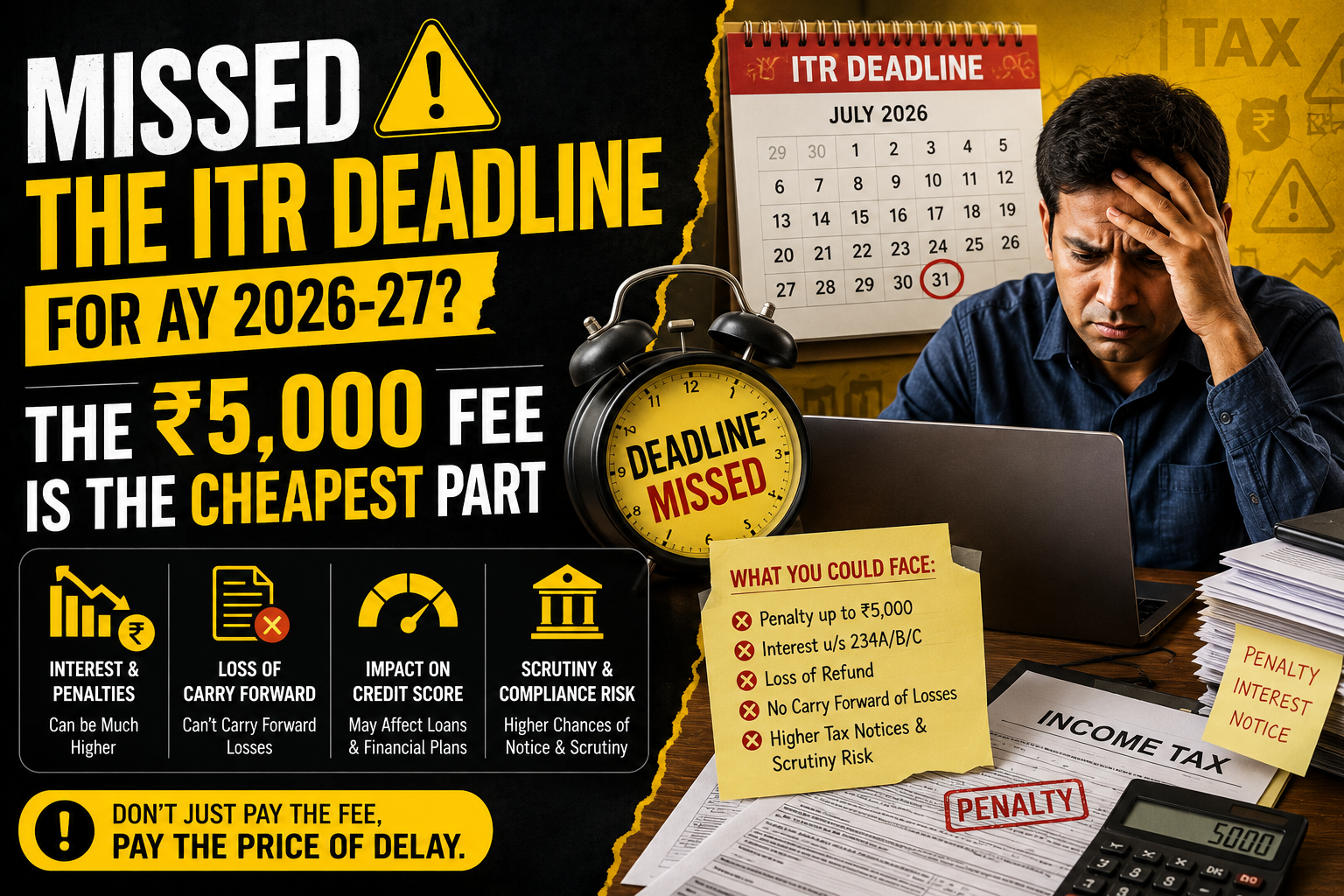
If you didn’t file your income tax return by 31 July 2026, the first number you’ll see quoted everywhere is ₹5,000. That’s the late fee under Section 234F. It is also, for most people reading this, the smallest thing you lost.
Two other consequences of missing the deadline cost real money, and neither of them is reversible. One takes away your right to carry forward capital and business losses. The other locks you into the new tax regime for the entire year, whether it suits you or not. Between them they can run into lakhs.
This piece walks through all of it — the fee, the interest, the two irreversible losses, what a belated return can and can’t fix, and exactly what to do this week. Some of it is bad news. Some of it is more forgiving than people assume.
Which ITR deadline actually applied to you
Not everyone had a 31 July 2026 deadline. Assessment Year 2026-27 runs on a staggered calendar, and a lot of people who are panicking today weren’t actually late.
| Who you are | ITR form | Due date for AY 2026-27 |
|---|---|---|
| Salaried, pensioner, one house property, simple income | ITR-1 | 31 July 2026 |
| Capital gains, multiple properties, foreign assets, no business income | ITR-2 | 31 July 2026 |
| Business or professional income, no audit required | ITR-3 | 31 August 2026 |
| Presumptive taxation under 44AD / 44ADA / 44AE, no audit | ITR-4 | 31 August 2026 |
| Accounts subject to tax audit | ITR-3 / ITR-5 / ITR-6 | 31 October 2026 |
| Transfer pricing cases (Form 3CEB) | Various | 30 November 2026 |
The 31 August date for ITR-3 and ITR-4 non-audit filers is new, and it is worth being clear about: it’s a permanent change brought in by the Finance Act, 2026, not a one-off extension. Freelancers, consultants, doctors, small traders and anyone filing under presumptive taxation have a full extra month. If that’s you, stop reading in a panic and go file calmly — you have until 31 August 2026.
Everyone else — salaried employees, pensioners, people with capital gains, NRIs filing ITR-2 — had 31 July 2026.
Was the ITR deadline extended this year?
No. As of 31 July 2026, the Central Board of Direct Taxes has issued no notification extending the deadline for AY 2026-27, and CBDT officials publicly stated there was no such discussion underway.
Three things made an extension less likely this year than last. Over 4 crore returns had already been filed well before the deadline. The e-filing portal ran without the major outages that plagued earlier cycles. And the staggered calendar itself spread server load, because ITR-3 and ITR-4 filers were no longer competing for bandwidth on the same day.
Last year was different — for AY 2025-26 the CBDT did push the individual deadline from 31 July 2025 to 15 September 2025, and then by one more day after technical glitches. Plenty of people were waiting for a repeat. It didn’t come.
If you’re reading this later in the year, check incometax.gov.in directly before relying on anything. An extension, if one is ever issued, appears there as a formal CBDT notification and nowhere else first.
Late fee under Section 234F: how much you’ll actually pay
Section 234F charges a flat fee for filing after the due date. It is a fee, not a penalty, which means there is no discretion involved and no officer to appeal to. The e-filing portal will not let you submit a belated return until it’s paid.
| Your total income | Fee under Section 234F |
|---|---|
| Above ₹5,00,000 | ₹5,000 |
| Up to ₹5,00,000 | ₹1,000 |
| Below the basic exemption limit (₹4,00,000 new regime / ₹2,50,000 old regime) | Nil — but only if you weren’t otherwise required to file |
That last row catches people out. If your income is below the exemption limit but you’re required to file for another reason — foreign assets, high-value transactions, or because you want a refund of TDS that was deducted — the fee position depends on whether filing was mandatory in your case. Where filing was mandatory and you’re late, Section 234F applies regardless of how small your tax was.
The fee is the same whether you file on 1 August or 30 December. It does not accrue. Which brings us to the thing that does.
Interest under Section 234A: the part that grows
Section 234A charges simple interest at 1% for every month or part of a month on any unpaid tax, running from the day after the due date until the date you actually pay.
Two details matter here. First, “part of a month” counts as a full month, so filing on 2 August and filing on 30 August cost you exactly the same interest. Second, and this is the one people get wrong: if your tax was already fully paid through TDS and advance tax, Section 234A interest is nil. Late filing on its own doesn’t attract interest — unpaid tax does.
So a salaried person whose employer deducted TDS correctly and who has no other income owes ₹5,000 and nothing more. Someone with ₹2,00,000 of unpaid self-assessment tax who files in November owes roughly ₹8,000 in 234A interest on top of the fee, and that’s before Sections 234B and 234C for advance tax shortfalls, which are separate and can apply at the same time.
The losses you can no longer carry forward
This is the expensive one, and it is permanent.
Section 80, read with Section 139(3) of the Income-tax Act, 1961, says that if you don’t file your return of loss by the due date under Section 139(1), you cannot carry those losses forward to future years. Not “you carry them forward with a penalty.” You lose the right entirely. A belated return doesn’t restore it. An updated return doesn’t restore it. There is no appeal.
| Type of loss | Section | Carry forward after a late filing? |
|---|---|---|
| Short-term capital loss | 74 | Lost |
| Long-term capital loss | 74 | Lost |
| Business loss (non-speculative) | 72 | Lost |
| Speculation business loss | 73 | Lost |
| Specified business loss | 73A | Lost |
| Loss from owning and maintaining race horses | 74A | Lost |
| Loss from house property | 71B | Survives |
| Unabsorbed depreciation | 32(2) | Survives |
What this costs a retail investor in rupees
Say FY 2025-26 was a rough year and you booked ₹4,00,000 of short-term capital losses on equity. Filed on time, that loss carries forward for eight assessment years and shelters ₹4,00,000 of future short-term gains from tax at 20%. That’s ₹80,000 of tax you would never have paid.
File on 1 August instead of 31 July and that ₹80,000 is gone. The late fee was ₹5,000. The actual cost was sixteen times that, and it doesn’t show up anywhere on your return — you simply never get to claim it in some future year when you finally have gains.
The mistake that makes this worse: people with losses often assume that because they have no tax to pay, there’s nothing urgent about filing. It’s the exact opposite. A loss year is the year where filing on time is worth the most money.
The two losses that survive a late filing
Section 80 lists the losses that are barred. Two important ones aren’t on that list, and the omission is deliberate.
Loss from house property under Section 71B can be carried forward for eight years even if you file a belated return. If you have a let-out property where interest on the home loan exceeds the rental income, or the ₹2,00,000 self-occupied interest cap left you with an unabsorbed balance, that carry-forward is intact.
Unabsorbed depreciation under Section 32(2) also survives, and it carries forward indefinitely with no eight-year limit. It is treated as part of the following year’s depreciation allowance rather than as a brought-forward loss, which is why Section 80 doesn’t touch it. The Delhi High Court has confirmed this position.
Current-year set-off still works
Separately, and this is the piece most articles skip: Section 80 only restricts carry forward. It says nothing about set-off within the same year.
So even in a belated return you can still set off this year’s losses against this year’s income under the normal Sections 70 and 71 rules — short-term capital loss against any capital gain, long-term capital loss against long-term gain, business loss against most heads other than salary. You just can’t push whatever remains into next year.
If your FY 2025-26 losses and gains roughly cancel out within the year, filing late may cost you very little beyond the fee. If you booked losses and had no gains to absorb them, you’ve lost the entire benefit.
The tax regime lock: the consequence nobody warns you about
Here is the second irreversible cost, and for salaried taxpayers it’s often larger than the loss carry-forward one.
Since AY 2024-25, the new tax regime under Section 115BAC is the default. You can opt out and be taxed under the old regime — but only if you exercise that option by the due date under Section 139(1). File a belated return and the option is gone. You are taxed under the new regime for that entire year, regardless of what you intended.
For taxpayers without business or professional income, the choice is made by answering the opt-out question inside ITR-1 or ITR-2, and it can be made afresh every year. For taxpayers with business or professional income, it requires Form 10-IEA filed on or before the Section 139(1) due date — and once withdrawn, a business taxpayer cannot go back to the old regime in later years.
What the lock costs: a worked example
A salaried employee in Delhi, gross salary ₹18,00,000 for FY 2025-26, with a genuinely deduction-heavy profile — ₹4,00,000 HRA exemption, ₹1,50,000 under Section 80C, ₹50,000 health insurance under 80D, ₹50,000 NPS under 80CCD(1B), and ₹2,00,000 self-occupied home loan interest.
| Old regime (filed on time) | New regime (forced, filed late) | |
|---|---|---|
| Gross salary | ₹18,00,000 | ₹18,00,000 |
| Standard deduction | ₹50,000 | ₹75,000 |
| HRA, 80C, 80D, NPS, home loan interest | ₹8,50,000 | Not available |
| Taxable income | ₹9,00,000 | ₹17,25,000 |
| Tax including 4% cess | ₹96,200 | ₹1,50,800 |
Extra tax purely because the return was filed a day late: ₹54,600.
Worth being fair about this, though. The new regime slabs for FY 2025-26 are generous — nil up to ₹4,00,000, then 5% to ₹8,00,000, 10% to ₹12,00,000, 15% to ₹16,00,000, 20% to ₹20,00,000 — with a ₹75,000 standard deduction and a Section 87A rebate that makes taxable income up to ₹12,00,000 completely tax-free. For a large number of salaried people the new regime is genuinely better, and being locked into it costs nothing at all.
The lock hurts a specific profile: high rent in a metro, a home loan, a fully-used 80C, and health insurance premiums for a family. If that’s you, run both regimes before you assume the damage is small.
What missing the deadline actually costs
The ₹5,000 fee is the smallest line item Illustrative, for a taxpayer with high deductions and ₹4 lakh of booked short-term capital losses 90,000 60,000 30,000 0 ₹5,000 Late fee Section 234F ₹54,600 Locked into new regime Section 115BAC ₹80,000 Carry-forward destroyed Section 80
Not everyone incurs all three. But the two big bars are the ones that never appear in a headline.
To be clear about what applies to whom: the ₹5,000 fee hits everyone who files late. The regime lock hits anyone whose old-regime deductions beat the new-regime slabs. The carry-forward loss only hits people who actually had losses to carry forward. A salaried person with no losses, no big deductions and fully-paid TDS genuinely does get away with ₹5,000 and a slower refund.
Filing a belated return under Section 139(4)
You can file a belated return for AY 2026-27 up to 31 December 2026, or before the assessment is completed, whichever is earlier. It’s the same ITR form, filed on the same portal, with the return type marked as belated under Section 139(4).
Do it soon rather than in December. Three reasons: Section 234A interest accrues monthly on any unpaid tax, refunds are processed in the order they arrive, and the “before completion of assessment” condition means the Department can in principle close the window early by assessing you.
Belated return: what changes and what doesn’t
- Still works: claiming a refund, claiming TDS credit, setting off current-year losses, reporting all income heads, revising it later.
- Still available: house property loss carry-forward, unabsorbed depreciation carry-forward.
- Gone: carry-forward of capital, business and speculation losses; the option to choose the old tax regime.
- Added: Section 234F fee, Section 234A interest on unpaid tax, and a later start date for refund interest.
One practical note: the portal requires self-assessment tax, including the 234F fee, to be paid before you can submit. Pay the challan first, then file. And remember to e-verify within 30 days — an unverified return is treated as never filed, which would put you back at square one with less time.
Belated vs revised vs updated returns
These three get confused constantly. They do different jobs.
| Belated — 139(4) | Revised — 139(5) | Updated (ITR-U) — 139(8A) | |
|---|---|---|---|
| Used when | You never filed by the due date | You already filed and need to correct it | All other windows have closed |
| Deadline for AY 2026-27 | 31 December 2026 | 31 March 2027 | 31 March 2031 (48 months from end of AY) |
| Precondition | None | An original or belated return must already exist | None |
| Can you claim a refund? | Yes | Yes | No |
| Can you carry forward losses? | Only house property loss and depreciation | Only what the original return preserved | No |
| Can you switch tax regime? | No | Yes, if the original was filed on time | No |
| Extra cost | 234F fee + 234A interest | Nil if filed by 31 December; a fee applies after that | 25% to 70% additional tax on top of tax and interest |
The revised return window running to 31 March 2027 is new — Budget 2026 extended it from the old 31 December cutoff. A late revision now carries a fee, so check the current position with your CA before revising after December.
A quirk worth knowing: a belated return can itself be revised. So if you’re up against 31 December with incomplete documents, file the belated return with your best figures and revise it by 31 March 2027. What you cannot do is revise your way back into the old tax regime — that door closed on 31 July.
Will you still get your refund?
Yes. Filing late does not forfeit a refund. If TDS was over-deducted or you paid excess advance tax, file the belated return by 31 December 2026 and the refund will be processed normally.
What you lose is some of the interest on it. Under Section 244A, when a return is filed after the due date, interest on the refund runs from the date you actually filed rather than from 1 April of the assessment year. At 0.5% per month, on a ₹50,000 refund filed four months late, that’s a few hundred rupees — small, but it’s the government keeping your money for free.
Refunds from belated returns also tend to sit lower in the processing queue than those from timely returns.
Notices, best-judgment assessment and prosecution
For the overwhelming majority of people this section is theoretical. It’s here because the fan of “what happens if I never file” questions deserves a real answer.
If you simply don’t file, the Department can issue a notice under Section 142(1) requiring you to. If income has escaped assessment it can reopen under Section 148. If you ignore both, it can make a best-judgment assessment under Section 144, estimating your income without your input — which never works in your favour.
Section 276CC does provide for prosecution in wilful failure-to-file cases: rigorous imprisonment of six months to seven years where the tax sought to be evaded exceeds ₹25,00,000, and three months to two years otherwise. In practice, prosecution is not launched where the tax sought to be evaded is ₹10,000 or less, or where an updated return has been filed under Section 139(8A).
Someone who files a belated return with tax paid is not in this territory. Someone who has ignored notices for years might be.
What if you miss 31 December 2026 as well?
Then the belated route closes and your only option is an updated return under Section 139(8A) — ITR-U — which you can file up to 31 March 2031, forty-eight months from the end of AY 2026-27.
It’s a poor substitute. ITR-U carries additional tax on top of the normal tax and interest, on a sliding scale by how late you are: roughly 25% if filed within twelve months of the end of the assessment year, 50% within twenty-four, 60% within thirty-six and 70% within forty-eight. You cannot use ITR-U to claim a refund, to report a loss, or to reduce your tax liability. It exists to let you declare additional income and pay for the privilege.
Which is the whole argument for filing your belated return in August rather than December, and in December rather than never.
One more reason this year matters: the Act is changing
AY 2026-27 is the last filing season governed by the Income-tax Act, 1961. Returns for income earned from 1 April 2026 onwards fall under the Income-tax Act, 2025, which also retires the twin terms “Previous Year” and “Assessment Year” in favour of a single “Tax Year.”
The relevant point for anyone filing late: the new Act does not grant fresh rights over old losses. A capital loss from FY 2025-26 that Section 80 barred because you filed belatedly stays barred. Losses that were validly carried forward keep their original character and their original expiry — a business loss from AY 2023-24 still runs out in AY 2031-32 regardless of which Act is in force.
So there’s no version of this where waiting helps.
What to do this week
If you missed 31 July 2026
- Check whether you were actually late. ITR-3 and ITR-4 non-audit filers have until 31 August 2026.
- Download your AIS and Form 26AS from the e-filing portal before you compute anything. Mismatches between these and your return are the single biggest cause of defective-return notices.
- Compute your tax under the new regime. The old regime is no longer available to you, so don’t waste time comparing.
- Pay self-assessment tax plus the 234F fee via challan. The portal blocks submission until this is done.
- File the belated return under Section 139(4) this month, not in December. Interest accrues monthly.
- Still set off your current-year losses. You lost the carry-forward, not the set-off. Claim every rupee of it.
- E-verify within 30 days. Aadhaar OTP is the fastest route. An unverified return counts as unfiled.
- Note the two dates that remain: 31 December 2026 for the belated return, 31 March 2027 to revise it.
Frequently asked questions
What is the last date to file ITR for AY 2026-27?
31 July 2026 for individuals filing ITR-1 or ITR-2, including salaried taxpayers and pensioners. 31 August 2026 for ITR-3 and ITR-4 filers not requiring an audit. 31 October 2026 for taxpayers whose accounts are subject to tax audit, and 30 November 2026 for transfer pricing cases.
Has the ITR deadline for AY 2026-27 been extended?
No. The CBDT has issued no notification extending the 31 July 2026 deadline for AY 2026-27, and officials stated no extension was under discussion. Over 4 crore returns had already been filed and the e-filing portal ran without major outages, both of which historically make an extension less likely. Verify on incometax.gov.in before relying on any claim otherwise.
What happens if I miss the ITR filing deadline?
Four things. You pay a late fee of up to ₹5,000 under Section 234F. You pay 1% per month interest under Section 234A on any unpaid tax. You permanently lose the right to carry forward capital, business and speculation losses. And you are locked into the new tax regime for that year and cannot opt for the old regime.
How much is the late fee for filing ITR after the due date?
₹5,000 if your total income exceeds ₹5,00,000, and ₹1,000 if it is ₹5,00,000 or less. No fee applies if your income is below the basic exemption limit and you were not otherwise required to file. The fee is fixed and does not increase the longer you wait.
Can I file my income tax return after 31 July 2026?
Yes. You can file a belated return under Section 139(4) up to 31 December 2026, or before your assessment is completed, whichever is earlier. It uses the same ITR form on the same portal, marked as a belated return.
Can I carry forward capital losses if I file a belated return?
No. Section 80 read with Section 139(3) bars the carry forward of short-term and long-term capital losses, business losses, speculation losses and specified business losses where the return was not filed by the Section 139(1) due date. The carry-forward is permanently destroyed and cannot be recovered by a belated or updated return.
Which losses can still be carried forward after a late filing?
Two. Loss from house property under Section 71B carries forward for eight years even in a belated return. Unabsorbed depreciation under Section 32(2) carries forward indefinitely, because it is treated as part of the next year’s depreciation allowance rather than as a brought-forward loss.
Can I still set off losses in a belated return?
Yes. Section 80 restricts only the carry forward of losses to future years, not set-off within the same year. In a belated return you can still set off FY 2025-26 losses against FY 2025-26 income under the normal Sections 70 and 71 rules. Only the unabsorbed balance is lost.
Can I choose the old tax regime in a belated return?
No. The option to opt out of the default new regime under Section 115BAC must be exercised on or before the due date under Section 139(1). Once that date passes, a belated return can only be filed under the new tax regime. For taxpayers with business or professional income, Form 10-IEA filed after the due date does not create a valid old-regime option for that year.
How much can being locked into the new tax regime cost?
It depends entirely on your deductions. For a salaried taxpayer earning ₹18,00,000 with ₹4,00,000 HRA exemption, full ₹1,50,000 Section 80C, ₹50,000 under 80D, ₹50,000 NPS and ₹2,00,000 home loan interest, the difference works out to roughly ₹54,600 of extra tax. For someone with few deductions the new regime is often cheaper anyway, and the lock costs nothing.
Will I still get my tax refund if I file late?
Yes. A belated return filed by 31 December 2026 still gets your refund processed. What changes is the interest — under Section 244A, refund interest runs from your filing date rather than from 1 April of the assessment year, so you receive less of it. Belated returns also tend to be processed later in the queue.
What is the difference between a belated return and a revised return?
A belated return under Section 139(4) is filed when you never filed by the due date, and the deadline for AY 2026-27 is 31 December 2026. A revised return under Section 139(5) corrects a return you already filed, and the deadline is 31 March 2027. A revised return requires that an original or belated return already exists.
Can a belated return be revised?
Yes. A belated return can be revised under Section 139(5) up to 31 March 2027 for AY 2026-27. This makes it practical to file with your best available figures before 31 December and correct them later. It does not let you switch tax regimes, because that option lapsed at the original due date.
What is ITR-U and when should I use it?
ITR-U is an updated return under Section 139(8A), filed up to 48 months from the end of the assessment year — 31 March 2031 for AY 2026-27. It is a last resort after the belated window closes. It carries additional tax of roughly 25% to 70% depending on how late it is, and cannot be used to claim a refund, report a loss or reduce your tax liability.
Do I have to pay interest if I file late but my tax was fully paid?
No. Section 234A interest is charged at 1% per month only on unpaid tax. If TDS and advance tax covered your full liability, the 234A interest is nil. The Section 234F late fee still applies regardless, because it is a fee for late filing rather than interest on tax.
Is there a penalty if my income is below the taxable limit?
No fee applies under Section 234F if your gross total income is below the basic exemption limit — ₹4,00,000 under the new regime, ₹2,50,000 under the old — and you were not required to file for any other reason. If filing was mandatory for you because of foreign assets, high-value transactions or similar triggers, the fee applies even though your tax is nil.
Can I be prosecuted for not filing my income tax return?
Section 276CC provides for prosecution in cases of wilful failure to file, with rigorous imprisonment of six months to seven years where the tax sought to be evaded exceeds ₹25,00,000, and three months to two years otherwise. Prosecution is not launched where the tax sought to be evaded is ₹10,000 or less, or where an updated return has been filed under Section 139(8A). Filing a belated return with tax paid takes you well outside this.
Does filing ITR late affect a loan or visa application?
Not directly, but practically it can. Banks and consulates routinely ask for two or three years of filed returns, and a belated return is clearly marked as such on the ITR-V acknowledgement. It doesn’t disqualify you, though a gap where no return was filed at all is a bigger problem than one filed late.
What happens to my losses under the new Income-tax Act, 2025?
Losses validly carried forward under the Income-tax Act, 1961 retain their original character and their original expiry period under the new Act. Losses that Section 80 barred because of a belated filing stay barred — the Income-tax Act, 2025 does not grant fresh carry-forward rights over them.
Is AY 2026-27 the last year under the old Income-tax Act?
Yes. Returns for AY 2026-27, covering income earned in FY 2025-26, are the last governed by the Income-tax Act, 1961. Income earned from 1 April 2026 onwards falls under the Income-tax Act, 2025, which replaces “Previous Year” and “Assessment Year” with a single “Tax Year.”
Key provisions referenced: Sections 139(1), 139(3), 139(4), 139(5) and 139(8A); Sections 70, 71, 71B, 72, 73, 73A, 74, 74A and 80; Section 32(2); Section 115BAC and Form 10-IEA; Sections 234A and 234F; Section 244A; Section 276CC — Income-tax Act, 1961, as amended by the Finance Act, 2026. Deadlines per CBDT for AY 2026-27.
This post is for general information and is not tax advice. Your position depends on your own facts, and rules change. Please confirm with a qualified chartered accountant before acting on anything here.