Rates stamp: Oct to Dec 2026 (Q3 FY 2026-27)
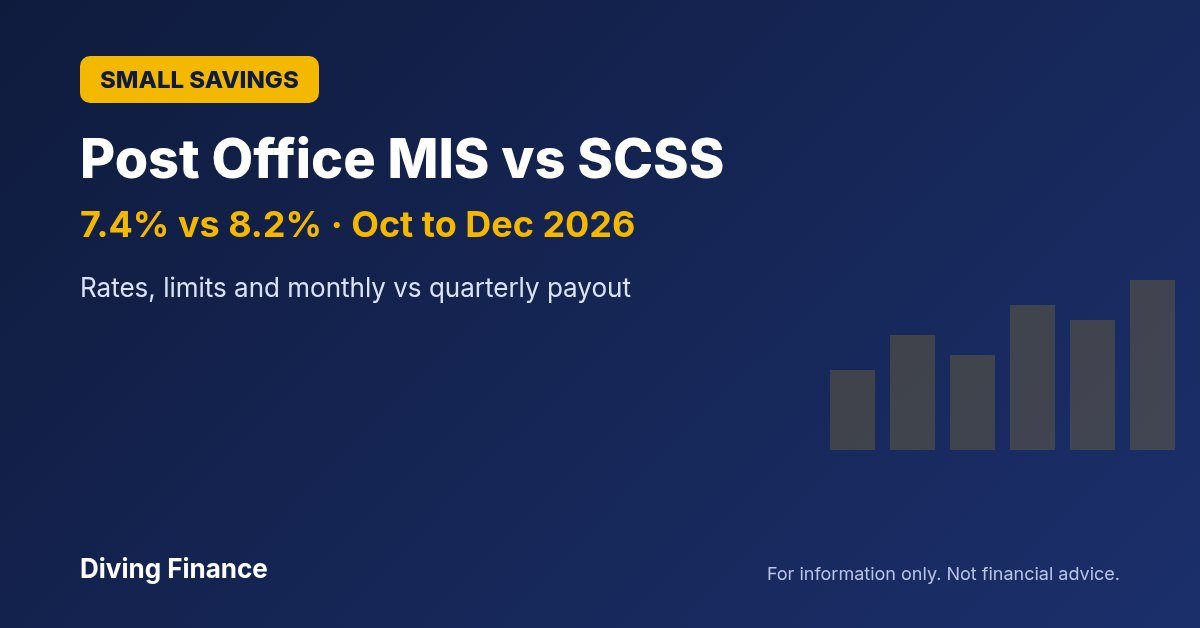
Post Office Monthly Income Scheme (MIS) and the Senior Citizens Savings Scheme (SCSS) are both government small-savings deposits that pay a fixed rate for five years. For Oct to Dec 2026, MIS pays 7.4% a year every month. SCSS pays 8.2% a year every quarter. SCSS needs age eligibility and allows a larger deposit. MIS is open more widely and pays cash every month.
Diving Finance is not a SEBI-registered investment adviser. The author and site do not hold positions discussed here as advice. This article is for education only and is not investment, tax or legal advice. Confirm scheme rules and tax treatment with India Post or an authorised bank and a chartered accountant before you invest.
Key Highlights
- Rates for Oct to Dec 2026: MIS 7.4% a year (monthly payout); SCSS 8.2% a year (quarterly payout). DEA left small-savings rates unchanged for this quarter (OM No. 1/4/2019-NS dated 30 Sep 2026; Department of Posts SB Order 12/2026).
- Deposit caps commonly applied: MIS Rs 9 lakh single / Rs 15 lakh joint; SCSS Rs 30 lakh per individual across accounts.
- Tenure: 5 years for both. SCSS can be extended for a further 3 years under scheme rules.
- Eligibility: MIS is open to resident adults (joint up to three adults under scheme rules). SCSS is mainly for age 60+, with limited early-retiree and defence paths.
- Interest on both is generally taxable at your slab. SCSS deposits may get an old-regime investment deduction within the overall limit. New Act section numbers still need confirmation.
- You can hold both schemes if you meet SCSS eligibility. Limits are separate.
- Live rate history: our SCSS rates page and Post Office rates page.
Quick comparison
| Feature | MIS | SCSS |
|---|---|---|
| Rate (Oct to Dec 2026) | 7.4% a year | 8.2% a year |
| How interest is paid | Monthly | Quarterly |
| Typical tenure | 5 years | 5 years (extendable by 3 years) |
| Min deposit (common) | Rs 1,000 | Rs 1,000 |
| Max deposit | Rs 9L single; Rs 15L joint | Rs 30L per individual |
| Who can open | Resident adult; joint allowed | Mainly 60+; early-retiree / defence paths |
| Deposit tax deduction | Generally none | Often old-regime investment deduction |
| Interest tax | Taxable at slab | Taxable at slab; TDS may apply |
Figures above are educational. Confirm the live counter rules before you deposit.
Current interest rates (Oct to Dec 2026)
The Department of Economic Affairs (Budget Division) said rates for the third quarter of FY 2026-27 (1 Oct to 31 Dec 2026) shall remain unchanged from the second quarter. That message is in OM No. 1/4/2019-NS dated 30 Sep 2026, circulated to post offices as SB Order No. 12/2026 dated 30 Sep 2026.
The National Savings Institute interest-rate table lists the prevailing percentages. For the current schedule those figures are:
| Scheme | Rate | Payout |
|---|---|---|
| 5 Year Monthly Income Account (MIS) | 7.4% a year | Monthly |
| Senior Citizens Savings Scheme | 8.2% a year | Quarterly |
For history and updates when the next quarter is notified, use our Post Office interest rates and SCSS interest rate pages. Related context sits on our PPF rate page and the October 2026 FD rates post.
Eligibility and deposit limits
Who can open SCSS
Under the Senior Citizens’ Savings Scheme rules published by the National Savings Institute:
- An individual who has attained 60 years on the date of opening.
- An individual aged 55 years or more but less than 60 who has retired on superannuation or otherwise, subject to opening the account within one month of receiving retirement benefits, with employer proof attached. (Some bank FAQs cite three months. Confirm the live rule text at the counter before you rely on either figure.)
- Retired personnel of Defence Services (excluding civilian defence employees) on attaining 50 years, subject to the other specified conditions.
- Account can be individual, or jointly with spouse. In a joint account, the first holder’s age decides eligibility. There is no age limit for the spouse as second applicant.
- Deposits in all SCSS accounts taken together must not exceed the maximum. Early-retiree deposits are capped at retirement benefits received or Rs 30 lakh, whichever is lower.
HUFs, NRIs and non-individuals are outside the usual retail path. Exact clauses for edge cases need expert and counter confirmation.
Who can open MIS
The National Savings (Monthly Income Account) Scheme is open to resident individuals. Joint accounts are allowed (commonly up to three adults under scheme rules). There is no senior-citizen age gate. Confirm the current application form and joint-holder rules at India Post or the authorised bank.
Caps: Rs 9 lakh / Rs 15 lakh vs Rs 30 lakh
MIS deposit limits were revised by G.S.R. 239(E) dated 31 Mar 2023 (Department of Posts SB circular): maximum Rs 9 lakh in a single account and Rs 15 lakh in a joint account. Minimum is commonly Rs 1,000 in multiples of Rs 1,000.
SCSS maximum is Rs 30 lakh per individual across accounts (raised from Rs 15 lakh by G.S.R. 240(E) dated 31 Mar 2023). Minimum is Rs 1,000 in multiples of Rs 1,000. There is only one deposit in an SCSS account.
How interest is paid: monthly vs quarterly
MIS pays interest every month into the linked savings account. SCSS pays interest quarterly (on or around the first working day of April, July, October and January for the preceding quarter, under the scheme’s payout calendar).
Illustrative pre-tax payouts at the Oct to Dec 2026 rates. These are education-only maths, not a quote from the counter:
| Deposit | MIS monthly (7.4%) | SCSS quarterly (8.2%) |
|---|---|---|
| Rs 5 lakh | About Rs 3,083 | About Rs 10,250 |
| Rs 9 lakh | About Rs 5,550 | About Rs 18,450 |
| Rs 15 lakh | About Rs 9,250 (joint MIS max) | About Rs 30,750 |
| Rs 30 lakh | Not available under MIS single/joint caps | About Rs 61,500 |
Formula used: annual interest = rate × principal; monthly = annual / 12; quarterly = annual / 4. Unclaimed interest does not earn further interest under common scheme guidance. Confirm rounding and credit dates at the post office or bank.
If you need a rough monthly cash plan for another product, our FD calculator can help you model bank FD alternatives. That is not a recommendation to switch.
Tenure, extension and premature closure
Both schemes typically run for five years. SCSS may be extended for a further three years by applying within the window set in the scheme rules. Extended SCSS earns interest at the rate applicable on the date of maturity for the extended period.
Premature closure is allowed subject to deductions that depend on how early you close. Bank and post-office summaries commonly cite SCSS deductions of about 1.5% of principal if closed after one year but before two years, and about 1% after two years but before five years, with no interest (and recovery of interest already paid) if closed within one year. MIS summaries commonly allow closure after one year with a 2% deduction before three years and 1% thereafter. Treat these percentages as secondary until you confirm the latest POSB / scheme rule text at the counter. Rules can be amended.
Tax treatment
The Income-tax Act, 2025 applies from 1 April 2026. New section numbers below follow secondary mappings from the old Act and need chartered-accountant confirmation before you file.
Interest
Interest from both MIS and SCSS is generally taxable as income from other sources at your slab rate. It is not tax-free. Cess and surcharge apply as per your income. See our tax articles for broader context.
Deposit deduction (SCSS only, old regime)
Secondary explainers (including Economic Times for the Oct to Dec 2026 rate round-up) say SCSS deposits may qualify for the investment deduction under Section 123 of the Income-tax Act, 2025 (mapped from old section 80C) within the overall Rs 1.5 lakh limit under the old tax regime. MIS deposits are generally not listed for that deduction. Check the Section 123 mapping, and whether the new regime allows any deposit deduction, with a tax adviser before you file. Our section 80C / section 123 guide lists related instruments.
TDS on SCSS interest
Bank FAQs commonly state that TDS may be deducted when SCSS interest crosses about Rs 50,000 in a financial year for a senior citizen, with Form 15H available where eligible. Thresholds and sections change. Check the current TDS section and threshold with your bank or a tax adviser before you rely on the figure.
Senior interest deduction
Eligible seniors may get a separate deduction on certain interest income under older rules (often discussed as 80TTB). Check the new Act section number and how it applies to SCSS interest with a tax adviser.
Can you hold both?
Yes, if you meet SCSS eligibility. The schemes have separate deposit caps. An eligible household can park money in SCSS up to its limit and still open MIS within the MIS limit. That is a feature comparison, not advice to split every maturity cheque. Match payout timing to your monthly expenses first.
For a wider survey of conservative options, see our safe investment options overview. For bank FD context in the same season, see FD interest rates October 2026.
Expert take
“Match the payout calendar to your expenses first. A higher rate that arrives quarterly still needs a cash buffer for the months in between. Check age eligibility and the live deposit cap at the counter before you move a PF or gratuity cheque. Interest is taxable on both schemes, so run the post-tax number with a chartered accountant rather than comparing only the headline rate.”
Ashutosh Joshi
Frequently asked questions
Is SCSS better than Post Office MIS?
SCSS currently pays a higher rate and allows a larger deposit, but you must meet age or early-retiree rules. MIS pays every month and is open more widely. Fit depends on eligibility and when you need cash. Confirm live rules before you deposit.
What are the MIS and SCSS interest rates for Oct to Dec 2026?
MIS 7.4% a year paid monthly; SCSS 8.2% a year paid quarterly. The government left small-savings rates unchanged for this quarter (DEA OM 30 Sep 2026; NSI table). Check our rates pages for updates.
Can I invest in both MIS and SCSS?
Yes. Limits are separate. Eligible investors can hold SCSS up to its cap and still open MIS within the MIS cap. Confirm both caps at the post office or bank before you transfer funds.
Is interest from MIS or SCSS tax-free?
No. Interest is taxable as per your slab in common guidance. Confirm filing with a CA. SCSS deposits may get an old-regime deduction within the overall limit. New Act section numbers need expert confirmation.
Does SCSS pay interest every month?
No. SCSS interest is paid quarterly. MIS pays monthly. If your expenses are monthly, plan a cash buffer between SCSS credit dates.
What is the maximum I can deposit?
Commonly: MIS Rs 9 lakh single or Rs 15 lakh joint; SCSS Rs 30 lakh per individual across accounts. Confirm at the post office or bank before you deposit. Early-retiree SCSS deposits can be capped at retirement benefits received.
Sources
- DEA OM No. 1/4/2019-NS dated 30 Sep 2026; Department of Posts SB Order No. 12/2026 dated 30 Sep 2026 (rates unchanged for Q3 FY 2026-27).
- National Savings Institute interest-rate table: https://www.nsiindia.gov.in/InternalPage.aspx?Id_Pk=132
- NSI SCSS scheme rules / deposit and eligibility pages: https://www.nsiindia.gov.in/InternalPage.aspx?Id_Pk=62 and Id_Pk=168
- G.S.R. 239(E) and G.S.R. 240(E) dated 31 Mar 2023 (MIS and SCSS deposit-limit revisions).
- India Post MIS limit circular (SB Order enclosing G.S.R. 239(E)).
Disclaimer
Diving Finance is not a SEBI-registered investment adviser. The author and site do not hold positions discussed here as advice. This article is for education only and is not investment, tax or legal advice. Confirm scheme rules and tax treatment with India Post or an authorised bank and a chartered accountant before you invest.