
Income Tax & ITR
Most salaried people pay less tax under the new regime in FY 2026-27 (tax year 2026-27). If your total income is up to Rs 12 lakh, you pay nothing at all, and with the Rs 75,000 standard deduction a Rs 12.75 lakh salary stays tax-free.
The old regime still suits a few people. You need big deductions to beat it: around Rs 5.94 lakh on a Rs 15 lakh salary, through section 80C (now section 123), home loan interest and health cover.
The rules now sit in the Income-tax Act, 2025, in force from 1 April 2026. Below you'll find the full slab guide, an old vs new regime comparison, how the tax structure in India works, and the traps people hit. Earning just over Rs 12 lakh is one. Capital gains that skip the rebate and a missed ITR deadline are the others.
Key Highlights
- New regime slabs for tax year 2026-27: nil up to Rs 4 lakh, then 5% to 30%; 30% applies above Rs 24 lakh (section 202, Income-tax Act, 2025; unchanged by the Finance Act, 2026).
- Rebate: up to Rs 60,000 for residents with total income up to Rs 12 lakh under the new regime, with marginal relief just above it (section 156, earlier 87A). Special-rate income such as equity gains generally gets no rebate.
- Standard deduction: Rs 75,000 for salaried taxpayers and pensioners in the new regime, Rs 50,000 in the old regime (section 19).
- Switching: salaried taxpayers can change regime every year when they file. Business owners who leave the new regime can come back only once (section 202(4)).
- Section 80C is now section 123: up to Rs 1.5 lakh, old regime only (section 123; Income Tax Department threshold limits).
Start with these guides
Income Tax Slabs FY 2026-27: New vs Old Regime Rates and Rebate
Every slab, the Rs 12 lakh rebate and worked examples.
Old vs New Tax Regime FY 2026-27: Which Is Better for You?
Find the break-even point for your deductions.
Section 80C (Now Section 123) Deductions: Full List for FY 2026-27
PPF, ELSS, insurance and more, up to Rs 1.5 lakh.
Tax Structure in India 2026: Direct Tax, GST and the New Income-tax Act
How India's tax system works, in plain English.
Missed the ITR Deadline for AY 2026-27? The Rs 5,000 Fee Is the Cheapest Part
What a late return really costs, and what to do now.
FD Interest Rates October 2026: SBI vs Post Office, Post-Tax Returns
What your FD actually earns after tax.
Calculators and rates
Plan PPF deposits that also count towards section 123 in the old regime.
Maturity value and interest, before you apply your slab rate.
EMI, SIP, RD and more money tools in one place.
What are the new regime slabs for tax year 2026-27?
| Total income | Tax rate |
|---|---|
| Up to Rs 4,00,000 | Nil |
| Rs 4,00,001 to Rs 8,00,000 | 5% |
| Rs 8,00,001 to Rs 12,00,000 | 10% |
| Rs 12,00,001 to Rs 16,00,000 | 15% |
| Rs 16,00,001 to Rs 20,00,000 | 20% |
| Rs 20,00,001 to Rs 24,00,000 | 25% |
| Above Rs 24,00,000 | 30% |
Frequently asked questions
Is income up to Rs 12 lakh really tax-free?
Yes, in the new regime, for a resident individual. Tax on Rs 12 lakh works out to Rs 60,000 (5% of Rs 4 lakh plus 10% of Rs 4 lakh), and the section 156 rebate wipes out exactly that. If you're salaried, add the Rs 75,000 standard deduction: a salary of Rs 12.75 lakh still lands at zero.
What if I earn just above Rs 12 lakh?
You don't fall off a cliff. Marginal relief caps your tax at the amount by which income crosses Rs 12 lakh. Take Rs 12.10 lakh. Slab tax is Rs 61,500, but you pay only Rs 10,000, or Rs 10,400 with 4% cess. The relief fades out at about Rs 12.71 lakh, where slab tax and the excess become equal.
Should a salaried person with a home loan stay in the old regime?
Usually not, unless your deductions are large. Take a Rs 15 lakh salary with Rs 1.5 lakh under section 123 (old 80C), Rs 2 lakh of home loan interest and Rs 25,000 of health cover. The old regime leaves Rs 10.75 lakh taxable and a bill of Rs 1,40,400 with cess. The new regime taxes Rs 14.25 lakh and charges Rs 97,500. That's Rs 42,900 in favour of the new regime. At this salary you'd need roughly Rs 5.94 lakh of total deductions, standard deduction included, before the old regime wins.
Does the Rs 12 lakh rebate cover capital gains?
Not fully. The rebate can't exceed tax worked out at the normal new-regime slab rates, so income taxed at special rates, such as gains on listed shares and equity funds, generally doesn't get it. Someone with Rs 9 lakh of salary income and a big equity gain can owe tax on the gain even though the total is under Rs 12 lakh.
Can I switch between regimes every year?
If you're salaried with no business income, yes. You choose when you file each year's return. Business and professional income is stricter. Opting out of the new regime has to happen by the return due date, the choice carries forward, and you can withdraw it only once. After that you're locked in unless the business income stops.
Can I still claim section 80C in the new regime?
No. The Rs 1.5 lakh deduction for PPF, ELSS, EPF and life cover (section 80C, now section 123) works only in the old regime. Keep investing if the product suits you. Just don't count on the tax break.
What happens if I miss the ITR deadline?
You can still file a belated return. Expect a Rs 5,000 late fee, cut to Rs 1,000 if total income is up to Rs 5 lakh, plus interest on any unpaid tax. You may also lose the right to carry forward some losses, and a late filer generally can't pick the old regime. Our missed-deadline guide walks through the fix.
What is the tax structure in India?
Two layers. Direct taxes such as income tax fall on what you earn and are run by the Central Board of Direct Taxes. Indirect taxes, mainly GST, sit inside the price of what you buy. Since 1 April 2026, income tax runs under the Income-tax Act, 2025, which replaced the 1961 Act.
Why file an ITR if my tax is zero?
Refunds, mostly. If your bank cut TDS on FD interest, the return is how you get it back. Lenders and visa officers also ask for ITRs as income proof, and a filed return keeps your loss carry-forward alive.
Expert take: Ashutosh Joshi
"Don't let tax decide where your money goes. I'm in the 30% slab and I still keep part of my portfolio in FDs. An emergency fund needs safety and quick access; a lower tax bill comes second."
"PPF is a good example. People open it for the old-regime deduction, then close it at 15 years. Extend it to 20 or 25 years instead. That's where the corpus really grows."
"Run your numbers under both regimes every year before you file. It takes ten minutes."
All Income Tax & ITR articles
Every guide on income tax, slabs, deductions and ITR filing, newest first.
VPF vs PPF: Interest Rates, Tax Limit and Who Should Use Which
VPF is extra money you choose to put into your own EPF account through payroll,…
Diwali Gifts and Tax 2026: The Rs 50,000 Rule vs Employer Gifts
Diwali falls on Sunday, 8 November 2026. If you receive a gift from your employer,…
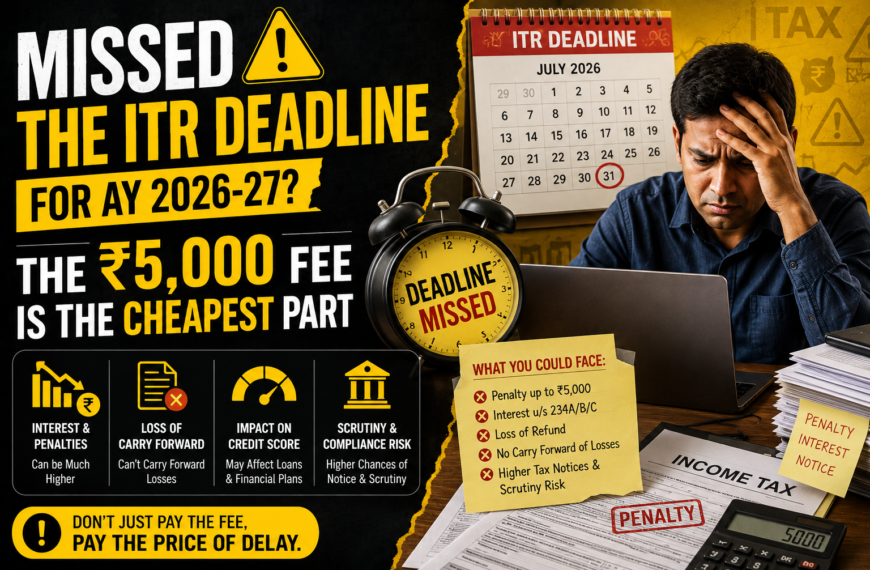
Missed The ITR Deadline For AY 2026-27? The ₹5,000 Fee Is The Cheapest Part
If you didn’t file your income tax return by 31 July 2026, the first number…
Tax Structure in India 2026: Direct Tax, GST and the New Income-tax Act Explained
Taxes are one of the most significant income sources for the government of India. Amount…

Top 10 Benefits of Filing Income Tax Return (ITR) in India (2026 Guide)
Income tax return (ITR) filing is a mandatory task in India, and you must file…
Section 80C (Now Section 123) Deductions: Full List for FY 2026-27
The Indian taxation system is designed so that the higher the income, the higher you…
Old vs New Tax Regime FY 2026-27: Which Is Better for You?
The Indian taxation system went through a drastic change when the new tax regime was…
Income Tax Slabs FY 2026-27: New vs Old Regime Rates and Rebate
For an economically and financially diverse country like India, it is unfair to levy tax…